


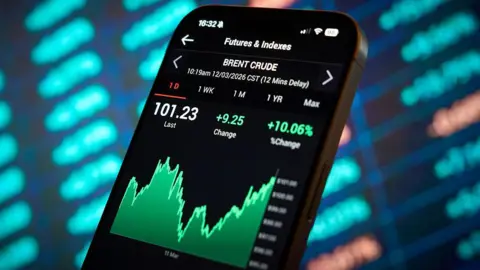
It is often difficult to pin down the factors guiding Donald Trump a month into the US and Israel's campaign of military action on Iran.
But it is clear he has an eye on the oil markets.
A statement – or tweet – from the American leader concerning his intentions once would spark significant swings in prices, as investors reacted to signs the hostilities could intensify or de-escalate.
However, in recent days, market players are showing signs of becoming increasingly wary about the impact of his comments.
The price of oil was hovering around approximately $72 a barrel (bbl) prior to 28 February, when the strikes on Iran began.
Recently, it reached a high of $118 a barrel on 19 March and by Friday afternoon was trading at slightly under $112 – significantly up from its pre-conflict price.
Here are several examples from the past month where Trump and the markets seem to have reacted to each other – with varying impacts.
Navigate with the navigation button to move to the following chart.
"Energy prices have come to represent broader political and financial uncertainties, surging when Trump's tone becomes confrontational and declining when his rhetoric becomes more conciliatory," observes one investment manager.
He adds that markets are rightfully attuned to those signals, considering the substantial macroeconomic threats that are associated with increasing oil prices.
"Traders are trying to assess authentic volatility," he comments. "Markets can seem jumpy or uncertain, but what they're really attempting is navigating geopolitical risk in the moment, with oil sitting right at the heart of that."
But, it can be tough for traders to figure out how to position themselves, especially since a portion of Trump's statements seem intended to influencing oil prices, rather than communicating official strategy, says another financial strategist.
"As they say, the initial victim of conflict is clarity," he remarks. "I suspect much of the communication back-and-forth around successful negotiations, and the opposite, very much are focused on merely influencing the market price of oil."
Investor Response Become Increasingly Subdued
On Thursday, minutes after US stock markets saw their biggest drop since the start of the conflict with Iran, Trump stated talks with Iran were going "quite positively" and he was putting off military strikes on Iran's oil facilities until at least 6 April.
But, the oil price continued to climb.
One head of FX strategy explains that investor responses are "becoming more muted" because of the "wide divergence" between Trump's reassurances and the absence of acknowledgement from Tehran.
"Considering the appearances, a large number of investors cannot envision an quick end to the conflict and financial markets remain anxious."
Another investment director says markets have also grown used to Trump "frequently shifting position at indications of political, stock market or economic trouble".
"There is a level of doubt, or even downright cynicism, emerging at the margins," he concludes.


